On Sept. 15, four of Ed Sheeran’s opening acts withdrew from the remaining North American dates of his “Loop” world tour. Lukas Graham, Aaron Rowe, Finneas and Irish folk band Beoga pulled out in protest and solidarity with American rapper Macklemore, who had been dropped from the tour after making pro-Palestinian comments onstage.
Upon being dropped from the tour, Macklemore expressed via Instagram that Sheeran was put in a difficult position.
“His typical apolitical stance was being challenged in a way it never had been before … But he couldn't get past his public facing, ‘I don't take sides,’” Macklemore said.
What followed was a wave of criticism toward Sheeran over what many perceived as neutrality and a lack of support for Macklemore, with some even calling for him to cancel the tour altogether.
Sheeran responded by stating that the decision to drop Macklemore was not his own, and that he “was not complicit” for choosing not to take a public stance on the conflict between Israel and Palestine.
“There is a reason I do not use my professional platform for politics,” Sheeran said. “My audience includes young people, often children, of all backgrounds. Those who come to my shows do not expect a political forum.”
In one way, despite the internet’s response, I don’t think Sheeran was entirely wrong to take the stance he did. Sheeran doesn’t owe the public a declaration of his personal beliefs and values, and being a famous musician does not automatically make him a political spokesperson.
What I do think is more interesting is his decision to draw a clear line between himself, his music and the political world altogether: he seems to understand his role as an artist as fundamentally separate from the political consequences of using — or choosing not to use — his platform.
A stance of this nature is not rare in our day and age. In fact, it seems to have become increasingly common with the rise of what I like to call the “apolitical artist.” German filmmaker Wim Wenders offered a clear example of this stance at the 2026 Berlinale Film Festival, arguing that filmmakers should stay out of politics because artists should be “the counterweight of politics” and should “do the work of people, not the work of politicians.”
Actor Neil Patrick Harris, speaking at the same festival, offered a similar view. Describing himself as something of a “jester in the castle,” Harris said that he is interested in doing things that are apolitical because the world is increasingly “algorithmic and divided” and, as artists, “we’re all as humans wanting to connect in some way.”
The apolitical artist, then, is not necessarily an artist who has no political beliefs. They are artists who argue that politics and art do not, or should not, intersect, and who perceive their work as existing outside of politics: a space where people can escape the divisions and conflicts of the world around them.
At first glance, this position does not seem unreasonable. There is nothing inherently wrong with wanting art to provide an escape from politics. In fact, there is something valuable about it. Movies, shows, books and music can be lightweight, playful and feel-good. We would live in a very depressing reality if every piece of media required us to confront the world's worst problems. Similarly, it would also be absurd to expect every artist to wear their heart on their sleeve and openly state their opinions about every political happening in the world.
So, naturally, we can’t expect (and possibly don’t want) every piece of art we are presented to be political. Nevertheless, that doesn’t mean art exists outside of politics altogether.
When we think about art, in its very essence, we think about a medium through which we seek to transmit something: a message, an experience, an emotion, an idea, a memory. Art, therefore, is a tool that we use to better understand and connect with the world around us.
Academic Frank Möller describes art as something that can articulate “a vision of the world that is insightful and consequential.” Art, he argues, can move audiences from what is to what “may be or could be or even, normatively, should be.”
In other words, art has the ability to help us make sense of the foreign and irrational while giving us the opportunity to analyze it and feel something about it. This is part of why art has so often been used to communicate political ideas. From Billie Holiday’s “Strange Fruit” and Keith Haring’s “Unfinished Painting” to Childish Gambino’s “This is America,” artists have historically used their work to make audiences confront realities that might otherwise feel distant or abstract.
And this is why I find arguments such as Harris’ or Wender’s so reductive. Art is created by people who exist within political, social and economic realities. It is consumed by people who exist within those same realities. The fact that a piece of art does not explicitly address those realities does not mean it was created outside of them.
Take actress Sydney Sweeney, for example, who has described her role as an actor as being about telling stories rather than speaking about politics. Yet her public image, commercial partnerships, roles, statements and participation in public campaigns have repeatedly become subjects of debate because of their cultural and political implications. The point is not that Sweeney is trying to be a political activist; it is that calling oneself apolitical does not erase the cultural meaning of one's actions.
The same is true of Ed Sheeran.
When finally addressing the issue onstage, Sheeran said he has always aimed “not to be a political commentator of any kind,” because he wants his “music and shows to be about unity, not division.” He also said that while his “heart has been broken by the scale of devastation and loss of civilian lives” in Gaza, he has never wanted to be an “activist musician.”
Sheeran's music is not generally political. He sings about love, romance, family, grief, loneliness and mental health. His work asks audiences to connect with deeply personal emotions. We trust him, in some small way, to tell us something about what it means to love and lose and miss and need another person.
So how, as audiences, are we expected to connect with the work of someone who cannot — or refuses — to recognize his own intersection with the world that generates the very emotions he sings about? Sheeran himself may not consider himself complicit in the political situation, but the spaces he performs in, and the people and institutions that make those performances possible, are not necessarily removed from it.
And perhaps that is where the idea of the “apolitical artist” begins to fall apart. Not because every artist needs to become political, but because no artist creates in a world untouched by politics. Because if art is one of the ways we understand the world, feel our way through it and connect with one another, then artists are inevitably part of that process too.
Celebrities don't have to tell us what to think. But perhaps, every once in a while, they should be willing to show us that they are looking at the same world we are.
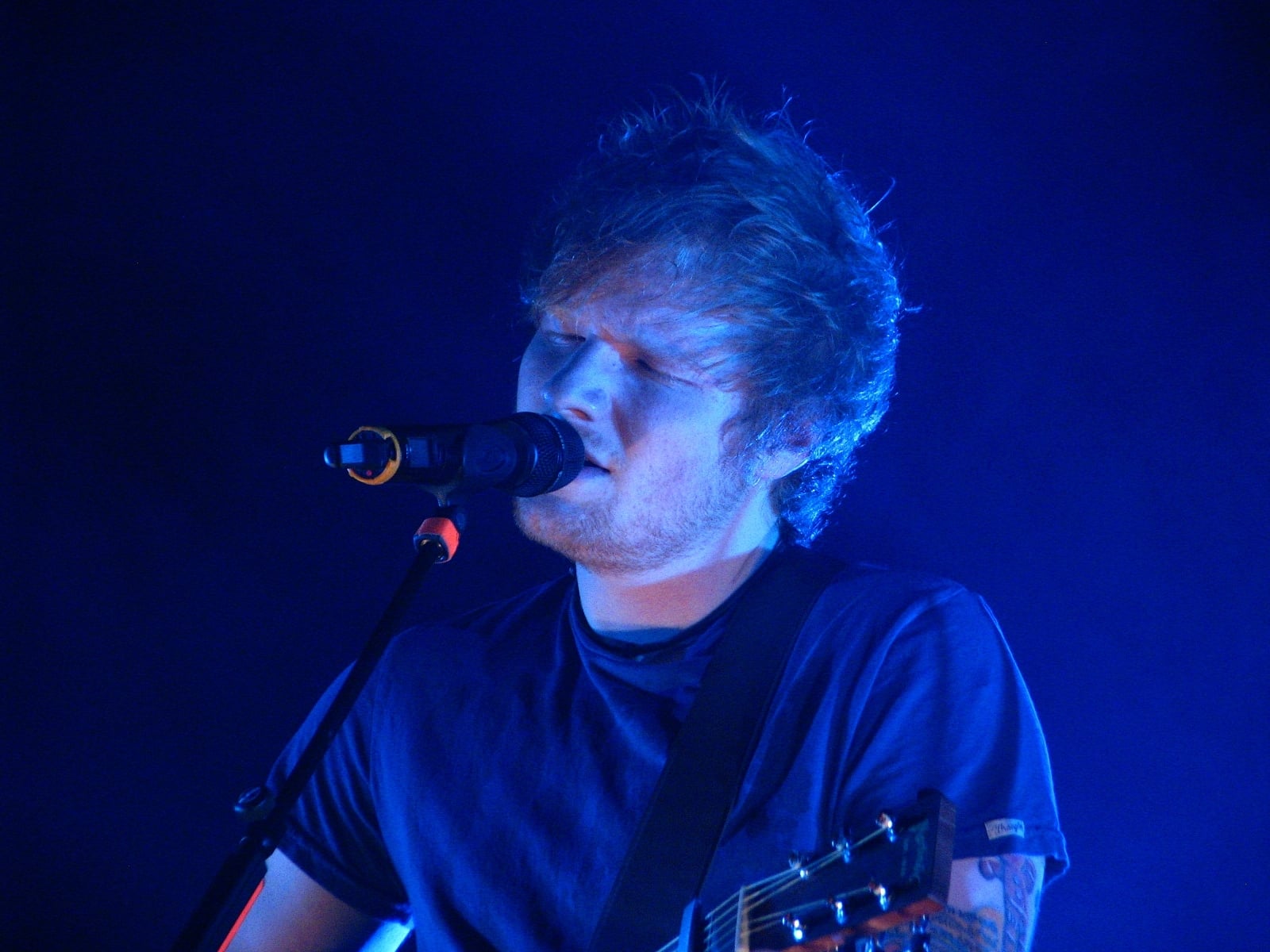
Photo by kaddyyy via Wikimedia Commons


.png)