On Oct. 15, the Center for Faith and Flourishing hosted an event titled “Can Religion Save Democracy?” The featured speakers brought two unique perspectives to the table: Matthew Kaemingk, professor of public theology at Theological University Utrecht, and Shadi Hamid, a columnist at The Washington Post. Kaemingk is a Christian theologian and Hamid is a Muslim political scientist who fall on different sides of the political spectrum. According to them, it is a friendship that “shouldn’t work but does” — after all, what common ground could they possibly have? However, both men have made it their mission to bring religion back into public life, proposing that religion by its very nature can sustain a healthy democracy. Their recent book “Can Religion Save Democracy?” explores this issue, acting as a testament to their argument that it is not only possible to collaborate across political and theological divides, but it is vital for democracy to thrive.
It is not difficult to see that American politics has grown increasingly polarized over the past three decades. Not coincidentally, membership in houses of worship has steadily declined, with only 47% of Americans belonging to a church, synagogue or mosque in 2020, down from 70% in 1999. For Kaemingk and Hamid, increasing political volatility is strongly correlated with the decreasing presence of religion in public life.
“All human beings long for transcendence,” Hamid said.
Traditionally, this longing had been fulfilled through involvement in religious communities, but as religious affiliation has declined in America, people find meaning in politics instead. As Hamid and Kaemingk’s book points out, this trend is deeply troubling — “Without a sense of something beyond us, everything becomes about us.” Elections feel more consequential and policy debates are more polarized when our identity is staked in them.
Religious communities, along with offering a perspective that puts politics in its proper place, are also an environment to practice democracy. During the event, Kaemingk illustrated this point by mentioning Alexis de Tocqueville, a French political scientist who visited America between 1831 and 1832. During his visit, Tocqueville noted how America’s religious freedom influenced its democracy among both individuals and the government.
“The character of Anglo-American civilization … is the product … of two perfectly distinct elements … I mean to speak of the spirit of religion and the spirit of freedom,” Tocqueville wrote in his book “Democracy in America.”
In any large population, there is a wide range of cultures, beliefs and ideologies, and America is no exception. Democracy requires citizens to engage with different opinions and perspectives. Similarly, there are significant differences even within religious communities that people must navigate. But Kaemingk and Hamid suggest that religious communities develop a level of intellectual humility — what they call the “God only knows” mindset — that is not only beneficial but vital to adopt in the public sphere. Every religion contains its own mystery, and by grappling with the unknown, people of faith cultivate a deep humility that allows them to face differing perspectives with “convicted civility.” An entire chapter of “Can Religion Save Democracy?” is focused on exploring this concept.
“The difference [between human confidence and human certainty] is absolutely critical for democratic life. Confidence in one’s beliefs is critically important for any democracy. Absolute certainty in one’s beliefs, on the other hand, is dangerous for any democracy. Chances are it won’t remain democratic for very long,” Kaemingk and Hamid wrote.
The solution for a thriving democracy is not fewer opinions, but rather a populace who can handle a diverse range of opinions well.
“Differences are the lifeblood of a healthy democracy,” Hamid said during the event.
Religious communities offer a foundational unity within them that serves as an anchor during disagreement. Peoples’ views may differ, but they collectively belong to something bigger than themselves that keeps them grounded through times of dispute, making compromise a realistic goal rather than a distant dream. Both Kaemingk and Hamid hope that this “convicted civility” can become a characteristic of American politics and public life.
“Democracy requires citizens who are willing to stay and contend,” Kaemingk said. “The most potent democratic power you have is how you interact with other people.”
The conclusion of “Can Religion Save Democracy?” calls people to this standard:
“Rather than requiring agreement, democracy requires something harder: the willingness to live with disagreement … [This] may be the most democratic thing religion has to teach us: how to live with what we cannot fully know, how to act on what we cannot prove, and how to remain in community with people whose deepest convictions we do not share. The hour is late. But the door is still open.”
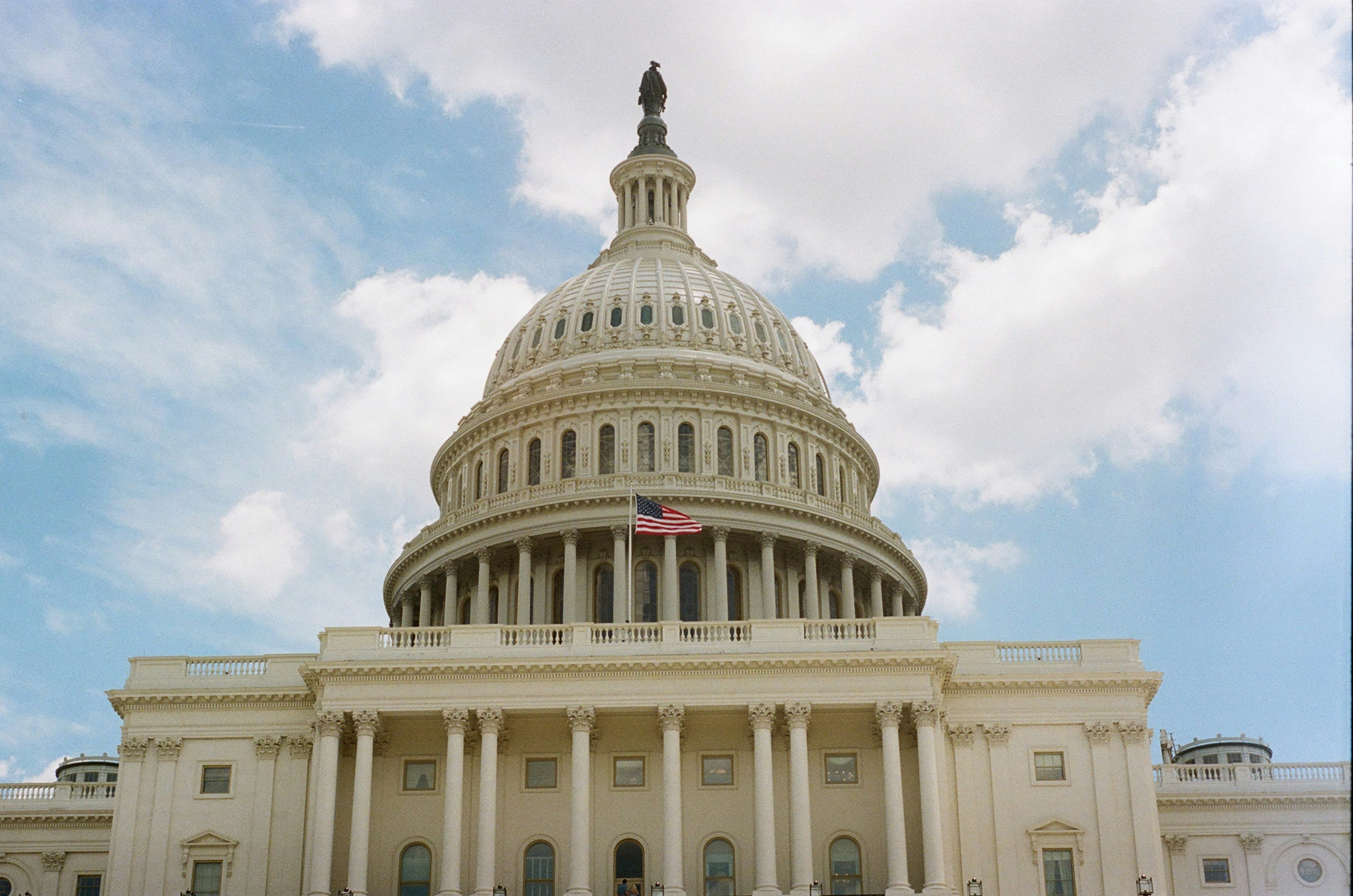
Photo by Sasan Hezarkhani on Unsplash