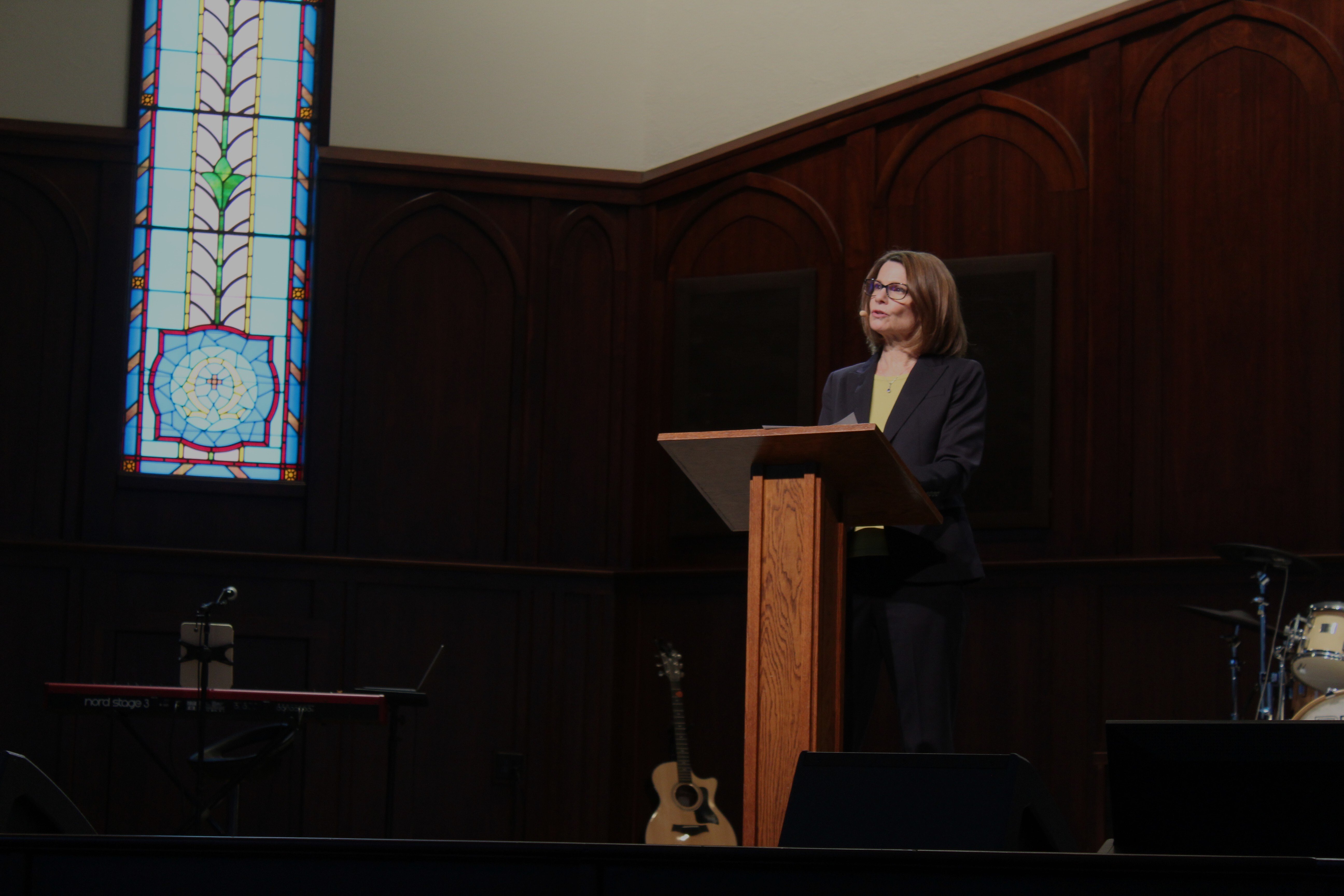
On Thursday, March 12, JBU students, faculty and staff packed into the Cathedral of the Ozarks and Simmons Great Hall A to hear from leading New Testament scholar Dr. Lynn Cohick. Cohick spoke at chapel about the women of Esther and led a talkback session later that evening titled: “Who Was the Samaritan Woman — Really?” Among her many credits, Cohick is a Distinguished Professor of New Testament and Director of Houston Theological Seminary at Houston Christian University and host of The Alabaster Jar Podcast. Cohick received her Ph.D. from the University of Pennsylvania and is the founder of the Center for Women in Leadership.
“Valor — a Quality for All” was the title of her chaper message, in which she walked the audience through the book of Esther. She argued for the quality of valor in both Queen Vashti and Queen Esther, while looking at the risks both women faced. For Queen Vashti, it was her dignity, and for Esther, it was the fate of her people. When evaluating Esther, Cohick spoke on the challenge she faced as she worked toward the well-being of her people as queen. Cohick said that this challenge was to use her power and agency as queen well, with wisdom and integrity.
Later that night, Cohick asked the question, “Who was the Samaritan Woman — Really?” Professors of Biblical and Theological Studies Dylan Parker and Kaitlyn Hawn were present, observing the audience as they piled in and pulled chairs from adjacent rooms. She began the story of the Samaritan Woman at the end, emphasizing the impact that the woman’s testimony, and evangelism had on the salvation of her town. By beginning at this part of her story, Cohick defined the Samaritan Woman as a “model disciple.” She proceeded to compare the contextual “typical” elements of her story, such as her identity in her marital status, engagement in religious conversation, testimony to her town, and the “atypical” elements, like her five husbands, discussion with a Jew as a Samaritan and the proclamation of her town of Jesus as Lord and Savior because of her evangelism. Through this comparison, Cohick offered a richer understanding of the Samaritan woman’s story than the sinful adulteress readers often default to. She argued that this story was not a story of sin and forgiveness as it is often told, but as an example of evangelism, the power of testimony and an example of women being involved with deeper theological discussion.
After her discussion on the story, Cohick opened up a time of questions moderated by Hawn. During this time, she discussed what education would have been typical or available for women in the historical context of the story. Inclusion in Scripture readings, discussion and the setting up of festivals would not have been abnormal.
“When reading and thinking about women in the New Testament, always remember that they are there,” Cohick said.
Another question posed asked how the story could be related to an egalitarian perspective. Cohick did not delve too deeply into this discussion, but left the audience with a statement to think about regarding how the story sets up the Samaritan woman.
“Imagine the model disciple as female,” Cohick said.
This statement connected back to her main points. Starting at the end of the Samaritan Woman’s story highlights her importance in evangelizing to her town, where the Apostles had just come from. Her interaction with Jesus and testimony introduced her town to the Savior of the world.
To hear the full Chapel talk, it can be found on the JBU Chapel podcast. For more information on the Samaritan Woman, a recent episode of Cohick’s podcast, The Alabaster Jar, with special guest and expert in theological studies, Dr. Cyndi Parker, continues the conversation. There, they discuss the context of the story and other prominent women in the New Testament.
Photo by Hope Brittenham